Is it safe to connect an AI agent to my WordPress site?
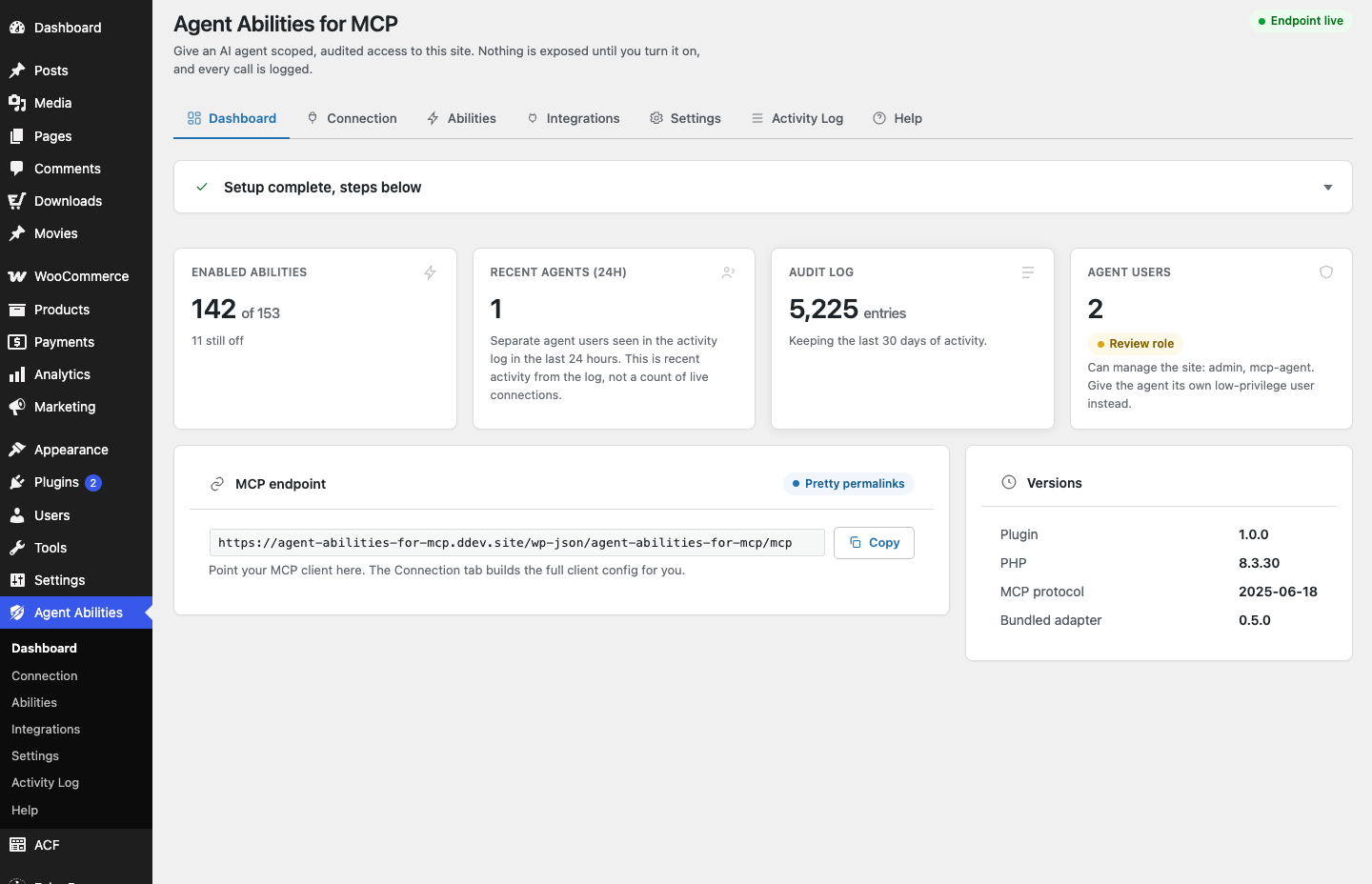
Yes, as long as the connection is scoped, and scoping is what Agent Abilities for MCP is built around. The agent connects as a real WordPress user and takes that account’s capabilities, so approve the connection while logged in as the account you want the agent to be. Point it at a least-privilege user and it can do no more than that user can do. Every ability stays off until you enable it. Every call is written to the audit log, denials included.
What is a WordPress MCP server?
It is a WordPress site that speaks the Model Context Protocol, so an AI client can discover and call the site’s abilities as tools. Agent Abilities for MCP turns any WordPress site into one, built on the WordPress 6.9 Abilities API and the official MCP Adapter, and wraps every ability in a governance layer: off by default, capped at the capabilities of the WordPress account the agent connects as, and audited on every call.
What can I ask an AI agent to do on my WordPress site?
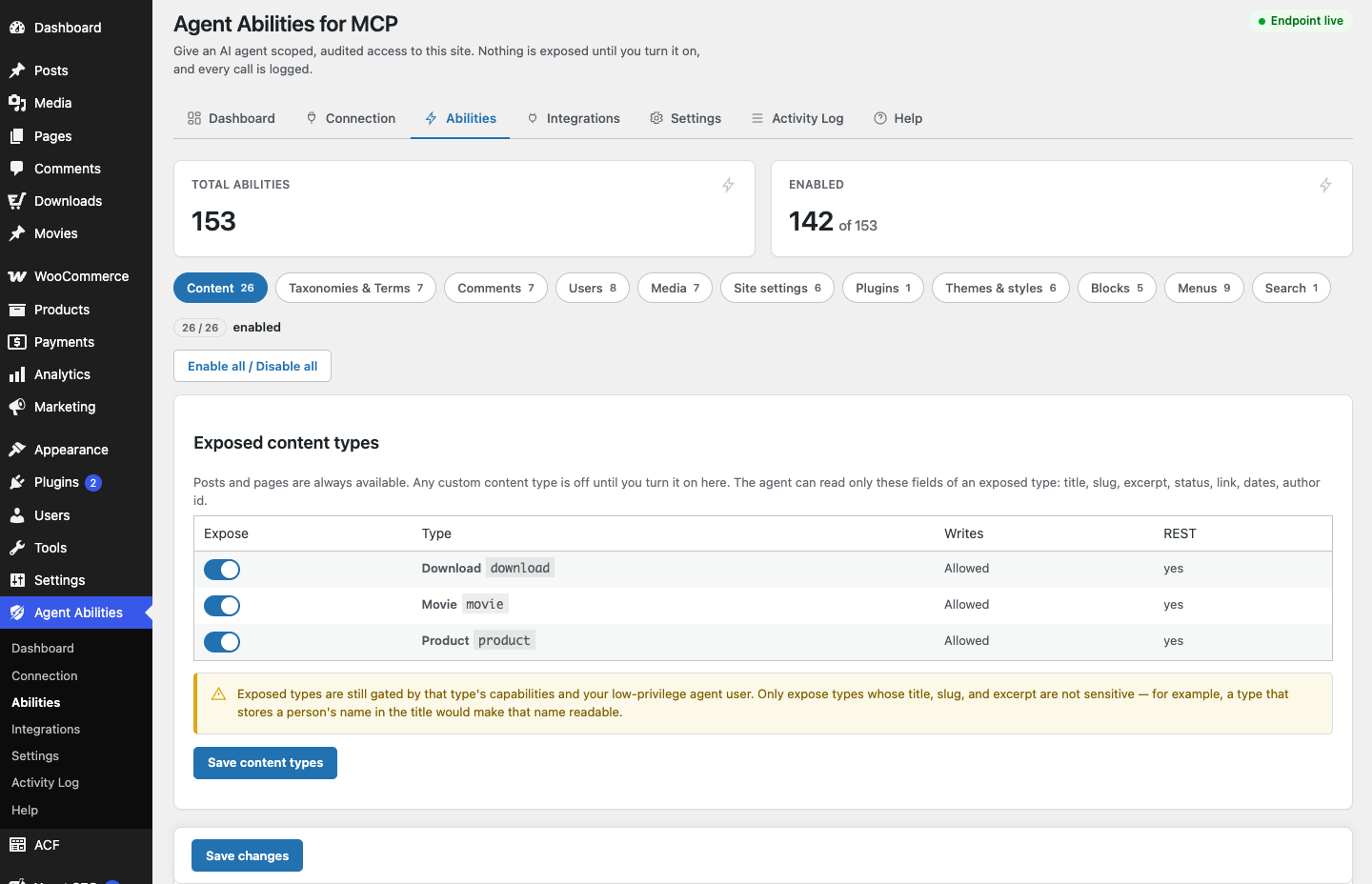
Whatever abilities you switched on, and nothing you did not. With the content abilities enabled, an agent can describe your site, count and search your posts, read a page and summarize it, draft a post for a human to publish, and fix a typo in place. It cannot publish, delete, or change settings unless you enable those abilities and bind the agent to a user that holds the capability. Every call is logged either way.
Can I give an agent read access without any write access?
Yes. Read-only mode is a switch on the Settings tab, and while it is on nothing that writes gets registered as an MCP tool, whatever you have ticked. A blocked write is missing from the agent’s tool list rather than refused when it calls. It covers abilities bridged from your other plugins as well, each judged by that plugin’s own annotation, and anything that declares neither way counts as a write and stays out, so the mode fails closed. Turning it on enables nothing by itself, and turning it off enables nothing either, so your selections are where you left them when you switch back. The switch is written to the audit log. It arrived in 1.6.0 and is off by default.
Does the agent get admin access?
Only if you connect it as an administrator. The agent takes the capabilities of the account it connects as. Over OAuth that is whichever account approves the connection in the browser, so log in as the dedicated low-privilege user the plugin creates before you approve, and the agent can only do what that user can do. An Application Password works the same way: generate it on that user rather than on your own admin account. Each ability re-checks the capability before it runs.
Is an Application Password limited to the abilities I enabled?
No, and the plugin says so rather than letting you assume otherwise. An Application Password is a whole-site WordPress credential, bounded only by the role of the user it belongs to, and Agent Abilities for MCP cannot narrow it. The IP allowlist, the high-risk lock, and the audit log govern the calls that arrive at the plugin’s own MCP endpoint; they do not follow that credential to the rest of WordPress. Issue it on a dedicated low-privilege user so that user’s role is the real limit, or connect over OAuth instead, where the token this plugin issues only ever authenticates this one endpoint.
Does uninstalling the plugin revoke my agent’s access?
Not on its own. Uninstalling removes the plugin’s settings and activity log, and its OAuth tables too if you turned on “Delete data on uninstall” first. It never removes the dedicated agent user or any Application Password issued to it, because those are ordinary WordPress account credentials that exist outside the plugin’s data. To actually cut an agent off, revoke its OAuth grant on the Connection tab, or delete its Application Password or its user account on the Users screen. Either works before or after you remove the plugin.
Does it send my content to OpenAI, Anthropic, or Google?
No. The plugin connects to no AI provider and makes no outbound requests of its own. Your own AI client connects in and calls the abilities you enabled.
Does it work with ChatGPT?
Yes. Agent Abilities for MCP works with ChatGPT through Developer Mode. Turn Developer Mode on in ChatGPT settings, then add your site as a custom connector. Approve it once over OAuth. ChatGPT then calls the abilities you enabled as the scoped user you pick. Custom connectors are a beta feature on ChatGPT’s paid plans. Claude.ai, Claude Desktop, and Manus connect the same way, through a custom connector, and Claude Desktop shares the one Claude.ai uses rather than running a bridge on your machine. Claude Code, Cursor, VS Code, Windsurf, and Gemini CLI connect as well.
How do I connect an AI agent to my WordPress site?
Install Agent Abilities for MCP, then open the first-run Quick Connect wizard on the plugin page. The wizard puts the whole first connection on one screen. For a hosted client like ChatGPT or Claude, turn on OAuth and copy the site endpoint. For a client that runs on your own machine, create a dedicated agent user and generate an application password. Either way, finish by switching on content reads. Nothing is exposed until you enable it. The wizard never turns on a delete.
Does it work with WPML?
Yes, and there is nothing to configure either way. On a WPML site the content reads take an optional language argument. They report back which language they returned, and a single-item read can fetch a specific translation. Agent Abilities for MCP reads only what WPML already holds. It translates nothing, and it makes no outbound calls. Sites without WPML are unaffected.
What is the difference between this and the WordPress REST API?
The REST API exposes raw endpoints. MCP describes your site’s abilities as discoverable tools an agent can reason about and call, and this plugin wraps each one in a governance layer: off by default, capability-gated on every call, and logged.
What happens if the agent tries to delete or break something?
The agent can only do what the WordPress user it connected as can do. Agent Abilities for MCP re-checks that capability before every call. Deletes go to Trash where WordPress supports it, so they can be restored. The last administrator can never be removed, no matter what the agent asks. Anything the agent is not allowed to do is refused. The refusal is written to the audit log too.
How is this different from other MCP plugins for WordPress?
Not on tool count. The agent enters as a WordPress user rather than through a key the plugin issues with a scope of its own, and WordPress re-checks that user’s capabilities before every call, in core rather than in code of ours. Every ability is off until you enable it, and every call lands in an audit log in your own database, refusals included. Several other WordPress MCP plugins now describe strict defaults and audit logs in similar terms, so the part worth checking is the rest: nothing in the chain belongs to a vendor, there is no external service, and there is no paid tier waiting behind the free plugin.
How does Agent Abilities for MCP compare to Easy MCP or Royal MCP?
All three are free WordPress MCP plugins. Easy MCP leads on raw tool count and external data connectors. Royal MCP leads on client breadth. Agent Abilities for MCP starts with everything off, gives the agent a WordPress account instead of an API key of its own, and makes no outbound calls. Easy MCP binds its token to a WordPress user too, so on identity the two of us are close; Royal’s API-key path runs as full admin. The site has honest, dated side-by-side comparisons for each.
Which WordPress MCP server should I use?
It depends on the job, so the site publishes a roundup of the whole field rather than an answer that always ends in us. AI Engine is the pick if you want a full AI suite with MCP as one part of it. Royal MCP documents the most clients and platforms. Easy MCP AI advertises the largest tool catalog and the only external data connectors. EMCP goes deepest into Elementor. Agent Abilities for MCP is the one that starts with everything off, hands the agent a WordPress account rather than a key of its own, and stays free at every tier. The roundup orders every plugin by active installs, which puts ours last, and it links to a head-to-head for each one.
What is the WordPress Abilities API?
WordPress 6.9 added a standard registry where plugins declare abilities: a name, a description, an input and output schema, a permission callback, and an execute callback. The official MCP Adapter reads that registry and exposes each ability to AI clients as an MCP tool. Agent Abilities for MCP builds its governed catalog on this API, and it can also bridge abilities that your other active plugins register.
Can I expose abilities from my other plugins?
Yes. WordPress 6.9 lets any plugin register abilities, and Agent Abilities for MCP can bridge the ones your other active plugins declare. They appear on an “Other plugins” screen, grouped by the plugin that registered them and off by default, so you turn on each one yourself, the same as the core abilities. Once enabled, a bridged ability runs under the same governance as the built-in catalog: scoped to the bound user, capability-checked on every call, rate-limited, and audited.
How do I see what changed in each release?
The changelog page lists every release, newest first, copied word for word from the plugin’s own readme. Permission and security fixes are written out in full rather than softened into a line about general improvements. Releases that change behaviour you might be relying on also carry an upgrade note, so you can see what to expect before you update.
Can an AI agent issue a refund or change a payment gateway?
Only if you deliberately allow it twice. Nine WooCommerce abilities in Agent Abilities for MCP move money or grant authority. They cover refunds, order status, order updates, customer updates, payment gateway settings, coupon creation and updates, and tax rate creation and updates. Turning one of those on is not enough by itself. It stays locked until you also switch on a separate high-risk control in Settings. That switch is written to the audit log like any other change. Everything else in the catalog needs only its own toggle.